Pew Fellow and Theater Artist Rebecca Wright on Plays as “Communication Acts”
Pew Fellow Rebecca Wright is a director and artist who emphasizes the importance of human connection in theater making. She has worked on stages from Philadelphia’s Arden Theatre (where she’ll direct John Proctor Is the Villain in 2027) to the Edinburgh Fringe (where Baby Everything, a play she co-developed with performer Lee Minora, ran to a warm reception in summer of 2026).
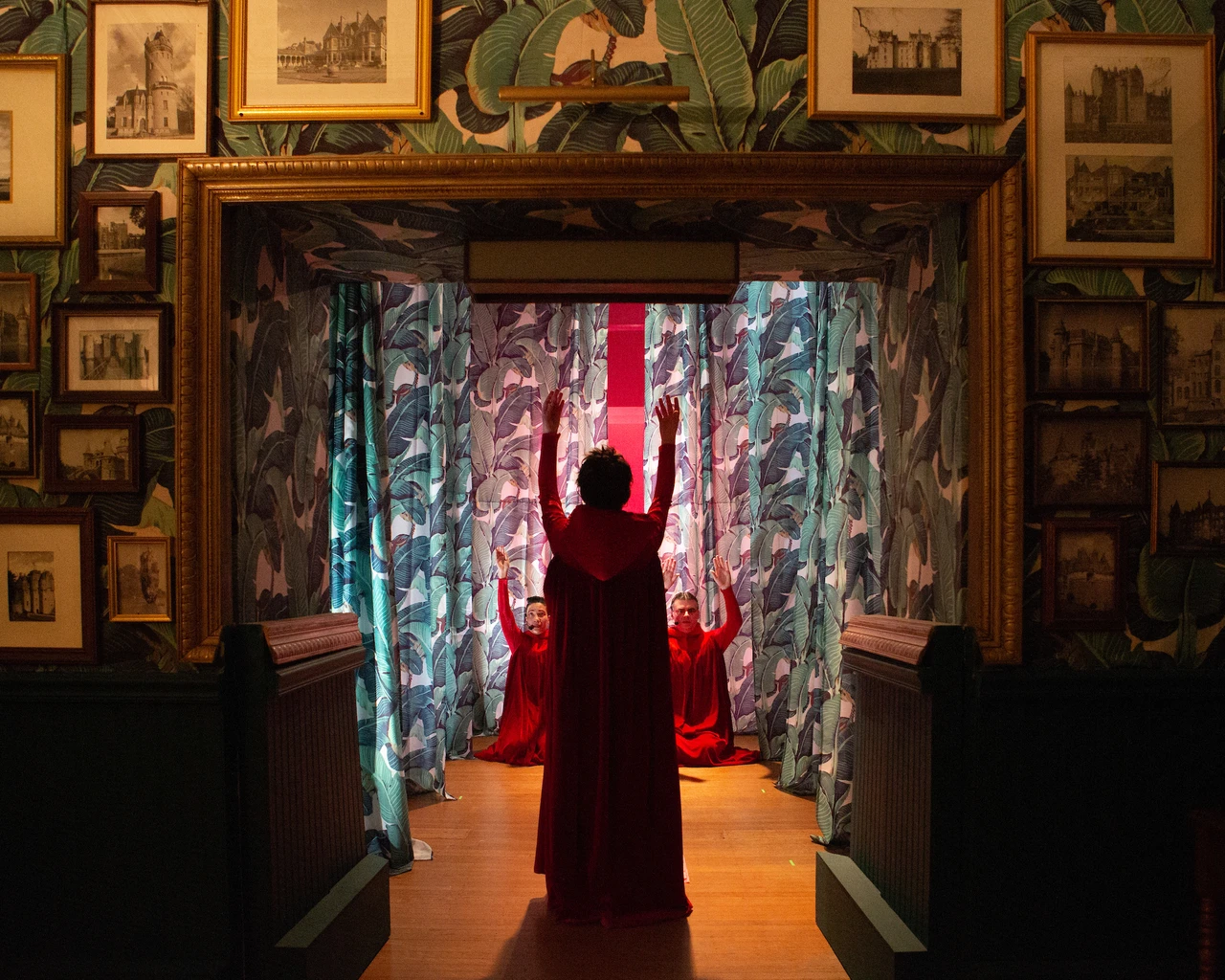
As Wright’s immersive theater company Applied Mechanics prepares its new work RUN BEN RUN for an October 2026 premiere at Christ Church Neighborhood House, she spoke with us about her artistic motivations and theater’s capacity for gathering, collaboration, and liveness.
Over the past five or ten years, what has surprised you in your own work?
I recently started asking people not to use their phones in my rehearsal room, and it’s made an enormous difference—in terms of focus, connection, and attention of the group, as well as the individuals in it. I think our work has become more inherently radical, as it requires physical presence and can’t happen on screens. I’m interested in finding ways to lean into that radicalism, to make every play a loud claim that we are human and that we need each other.
Plays are communication acts, and I’m interested in how they can push that communication beyond the realm of essays, articles, protests, and conversations. There’s no such thing as discourse on social media, just declarations. But a play can be a discourse. My conviction has increased that one of the great powers of plays is their capacity to express in non-literal dream worlds, in ecstatic or lyrical or evocative realms—and that is partly how they do their meaning making.
Amy Smith, Adriano Shaplin, and Severin Blake in Perfect Day, directed by Pew Fellow Rebecca Wright, The Private Theater, 2019. Photo by Kate Raines.
What is your core motivation as an artist? Has it changed over time?
I think I’ve learned about my motivation over time, but a lot of it has fundamentally stayed the same. I like to make things with people and share those things with other people. Doing this is how I love, how I learn about the world, and how I explore my biggest questions. When Maria Shaplin and I started Applied Mechanics, I was very interested in putting some positive pressure on the performer-audience relationship—don’t sit back, relax, and enjoy the show! You’re here! You’re vital! We need you and love that you’re here! I was also very interested in actively democratizing viewership—rather than shining a light on one thing and telling people what to look at, inviting them to find their own angles and vantage points, to embrace multiplicity over singularity of experience.
Making work with Applied Mechanics for the past seventeen years has allowed me to learn a lot about audiences, viewership, communication, and relationship in performance. And while I still love all of those components of performance, the thing I’m currently most excited to learn about is groups: the groups of people that gather in artistic collaboration, stories about groups, the aspects of theater that are specifically about gathering, collaboration, and liveness. I am deeply motivated by a desire to learn, to keep learning.
Do you have a favorite portrayal of an artist in film, TV, or books?
I have deep affection for portrayals of artists who are just this side of successful, who are struggling with their sense of whether or not they’ve made it. There’s something deeply recognizable in the emotions of that headspace, and it’s also always a sort of cautionary tale about what happens if obsession with external metrics obscures your connection to your form. For me, embracing the surety of failure is the single most important thing that has enabled me to lovingly and confidently pursue a life in the arts.
I love Michelle Williams’ character in Kelly Riechardt’s film Showing Up. She’s this really meticulous sculptor of small, delicate statues, and her friend is a slightly more celebrated visual artist, and she’s just so bummed and jealous about it she can barely celebrate her own work.
"Embracing the surety of failure is the single most important thing that has enabled me to lovingly and confidently pursue a life in the arts."
I also love Inside Llewyn Davis: The portrayal of an artist who is good but not great, who makes all the wrong decisions, who is so bitterly, self-defeatingly obsessed with the perceived breaks he can’t catch that he also can’t enjoy himself or his art, which is right next to fame (Bob Dylan shows up in the background in one of the final scenes).
And I love Meg Howry’s book They’re Going to Love You, about a working choreographer in her 40s. A really lovely portrait of working artist life: being very, very good, working hard at a high level, piecing things together. It’s really meaningful to encounter portraits of working artists rather than famous artists. Working artists are what most of us are.
I notice, now that I’ve written this out, that none of these portrayals are of theater artists. Maybe the slight distance of the different medium allows me to revel in the vibes and challenges in a less critical way.
What is driving you to create at this moment?
Because making a play involves building a world with other people, plays are a way of insisting that another world is possible. I make plays to connect with the belief that humans are capable of imagining and creating alternative systems, alternative ways of being, alternative worlds. Theater can only happen in the here and now: you have to be there to see it. I love it because of its analog nowness, its demand that we share space, look at each other, consider each other, connect.