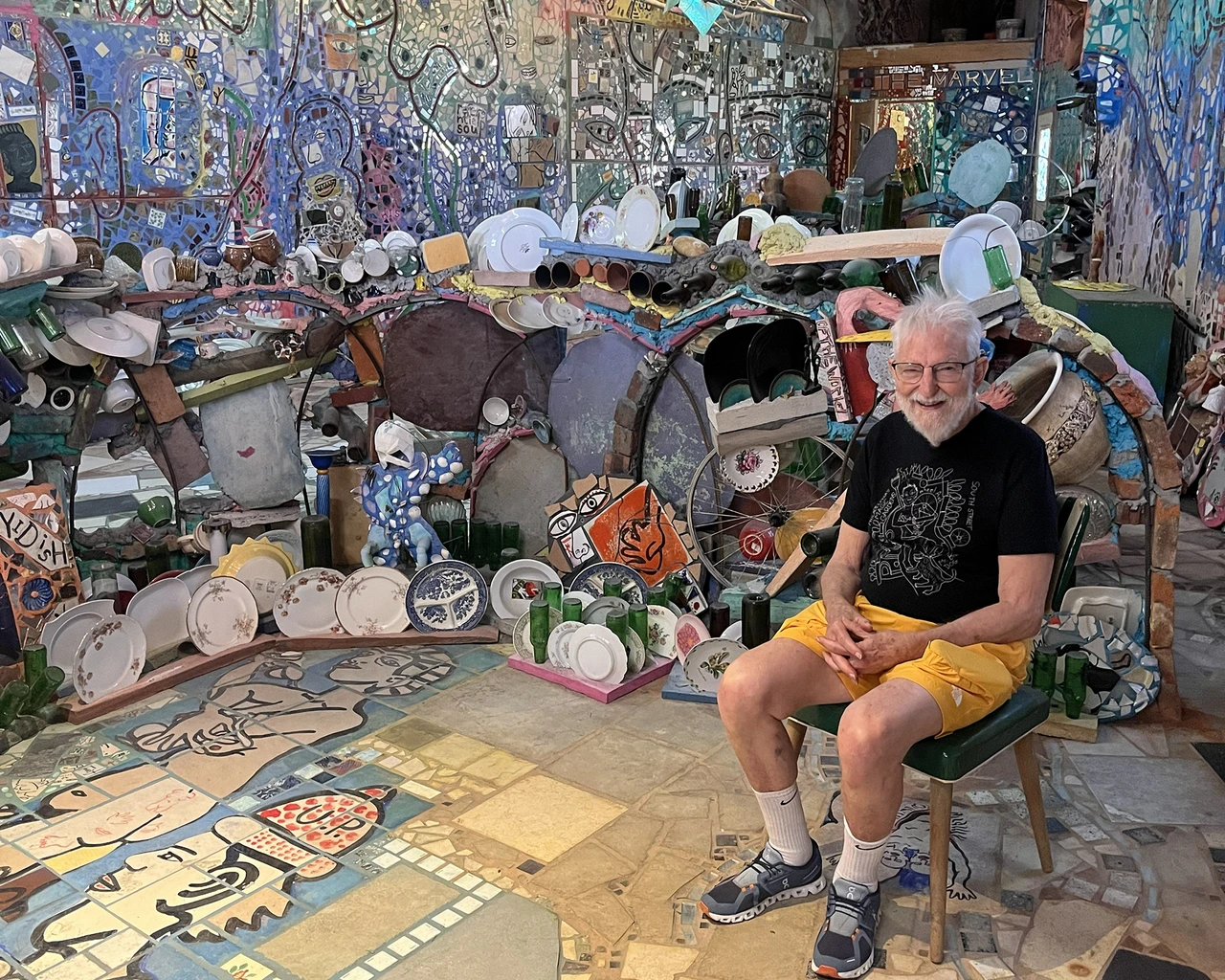
Isaiah Zagar, a 1995 Pew Fellow and a mosaic artist whose prolific body of public work shaped the visual landscape of Philadelphia, died on February 19, 2026, at his South Street home. He was 86.
For nearly six decades, Zagar honed a distinctive aesthetic: expansive concrete surfaces decorated in vibrant colors, embedded with chips of sparkling mirrors, painted ceramic tiles, and found objects like bike wheels and broken bottles. His work cultivates a sense of whimsy and wonder, covering an estimated 50,000 square feet of walls and buildings in his hometown, including Philadelphia's Magic Gardens, an immersive art space and museum.
"Isaiah was more than our founder; he was our close friend, teacher, collaborator, and creative inspiration," wrote Emily Smith, executive director of Philadelphia's Magic Gardens, in a statement online. "He was unlike anyone we have ever met and will ever meet. Above all things, he was an artist. In his lifetime, he created a body of work that is unique and remarkable, and one that has left an everlasting mark on our city."
Born in Philadelphia in 1939, Zagar grew up in Brooklyn, New York, and attended the Pratt Institute of Art, where he studied painting and graphics. He and his wife, artist Julia Zagar, served in Peru with the Peace Corps in the mid-60s, then moved to South Philadelphia in 1968, opening the Eye's Gallery on South Street to showcase Latin American folk art.
As The Philadelphia Inquirer reported, Zagar's mosaic work began in earnest in the 1970s, when he and Julia joined a group of artists and business owners to oppose the development of a crosstown expressway through their neighborhood. A South Street revitalization effort followed, and Zagar's work was its visual signature. In a 1993 interview with the Philadelphia Daily News, Zagar spoke of the transformational power of art: "My dream is [to] turn all of Philadelphia into tile city—to turn all these ugly old brick and stucco walls into a manifesto of magic."
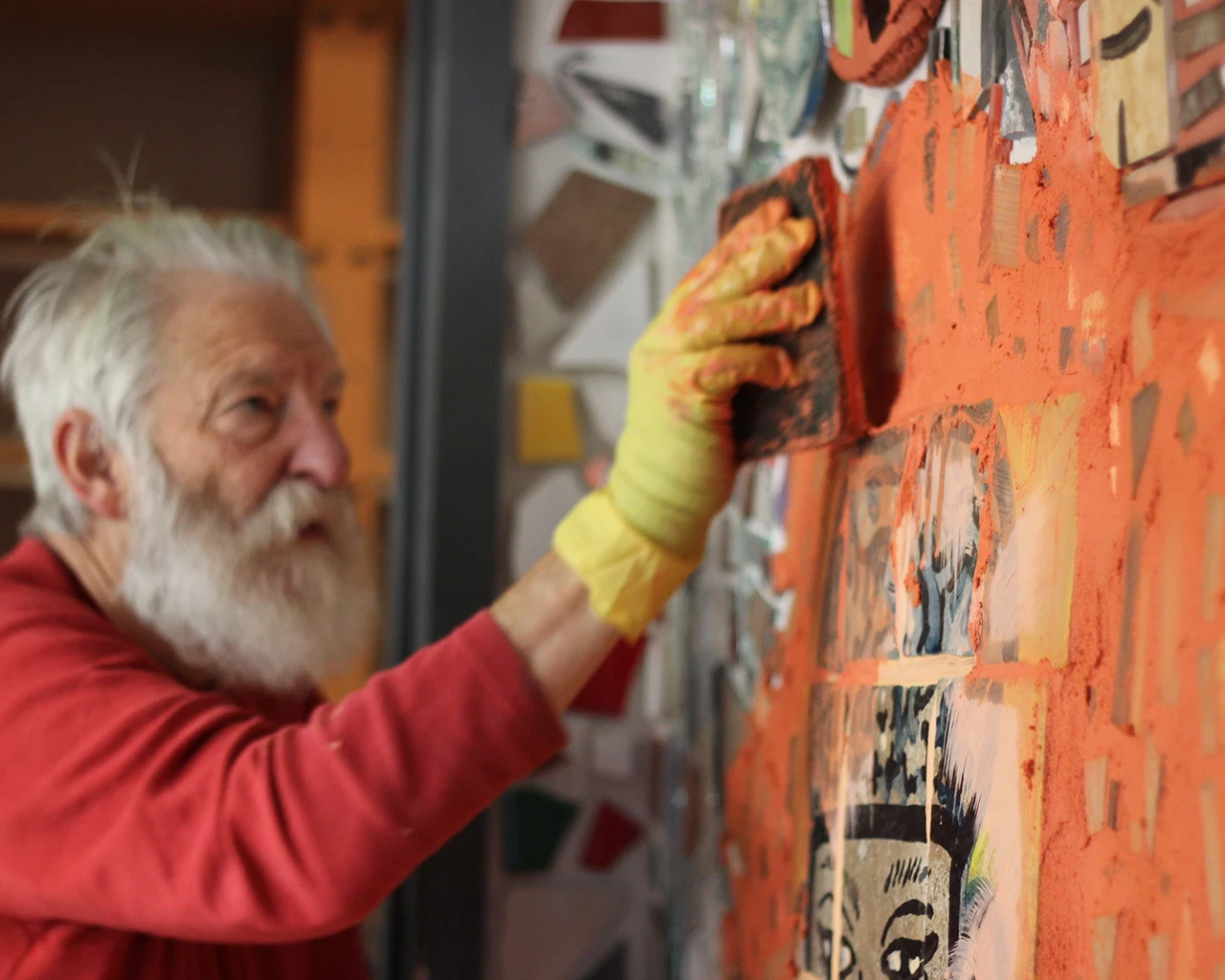
From 1991 to 2000, Zagar worked on Skin of the Bride, a 7,000-square-foot piece that covered the exterior of the Painted Bride Art Center's former location at 230 Vine Street in Old City. Beyond Philadelphia, his murals can be seen in more than 200 sites across North and South America, from Albany, New York, to Santiago, Chile. His work is held in the permanent collections of the Philadelphia Museum of Art, Pennsylvania Academy of the Fine Arts, The Fabric Workshop and Museum, and John Michael Kohler Arts Center.
Zagar's final studio, located in a converted auto repair shop on Watkins Street in South Philadelphia, was donated to Philadelphia’s Magic Gardens in 2023, and serves as a second space for the organization's programming—including a forthcoming exhibition, Held Within, supported by a 2025 grant from the Center. The project will showcase the textile-based work by the Chilean artist Carmen Mardonez, who will source materials from Zagar’s archives.
Read more about Zagar and his legacy in obituaries from The Philadelphia Inquirer, WHYY, ARTnews, and NPR’s Studio 2. For more on the imagery and motifs in his work, Philly Voice has a guide. And to find locations of Zagar's work around the globe, visit the Mosaic Mural Map on the Philadelphia's Magic Gardens website.